 howMed Know Yourself
The kidney has five major functions
Ø Removal of waste products/ toxic substances
Ø Regulation of water and electrolyte balance
Ø Regulation of acid-base homeostasis
Ø Conservation of Protein
Ø Endocrine functions
n Erythropoietin production
n Renin - angiotensin production
n Calcitriol- Vitamin D metabolism
Why Test Renal Function?
n To identify renal dysfunction.
n To diagnose renal disease.
n To reveal the principle site of pathology
n To assess the degree of functional damage
n To monitor disease progress.
n To monitor response to treatment.
Clinical history
Ø History of renal disease
Ø Evidence of systemic illness
Ø Family history of renal disease
Ø Medications being taken
Signs and Symptoms of Renal Diseases
n Symptoms of Uraemia (nausea, vomiting, lethargy)
n Disorders of Urine volume (polyuria, anuria)
n Alterations in urine composition (haematuria, proteinuria)
n Pain ( calculi)
n Oedema (hypoalbuminaemia, water retention)
n Disorders of Micturation (frequency, nocturia, retention, dysuria)
Biochemical Tests of Renal Function
n Urinalysis
n Appearance
n Specific gravity and osmolality
n pH
n Glucose
n Protein
n Urinary sediments
n Measurement of GFR
n Creatinine clearance tests
n Serum Creatinine/Urea
n Cystatin C
n Tubular function tests
Urine Routine Examination
n Appearance
n Urine volume (750-2500 ml/24h)
n Anuria: 100 ml/24 h
n Oliguria: 400 ml/24 h
n Polyuria: >3000 ml/24 h
n Specific gravity (1005-1020)
n Increased: Pre renal uraemia
n Decreased: Diabetes insipidus
n Fixed specific gravity e.g. CRF (1010)
n pH (5.5-8.0) - reflects acid base status
n Protein
n Glucose
n Formed elements
n Casts
n Crystals
24 hour urine protein excretion
v > 150mg/24 hour = proteinuria
v Gives a more accurate assessment of the severity of the proteinuria
v > 3.5 g/24 hour (with associated features) = nephrotic syndrome
Classification of Proteinuria
n Tubular proteinuria
n Tubular dysfunction
n Overflow proteinuria
n Glomerular proteinuria
n Selective proteinuria
n Non-selective proteinuria
n microalbuminuria
Urine microscopy
n To look for casts, white cells and red cells may give a clue to the diagnosis of:
n glomerulonephritis
n pyelonephritis
n tubular damage
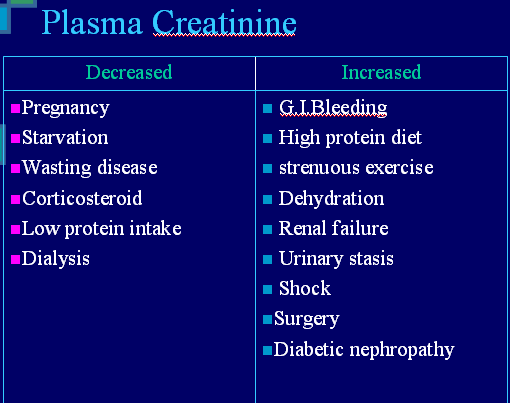
Serum Creatinine
n Reliable test for glomerular function
n Production determined by muscle mass which is related to age, sex and weight.
n Reference range- 70-133 umol/l
n Mild renal damage: <200 umol/l
n Moderate renal damage: 200-400 umol/l
n Severe renal damage: > 400 umol/l
Creatinine Clearance
n Most sensitive test for renal function
n The volume of blood from which creatinine is completely removed per unit time
n Clearance = (U x V)/P
n U is urinary concentration of creatinine
n V is the rate of urine formation (mL/min)
n P is the plasma concentration of creatinine
n Units = volume/unit time (mL/min)
n Cockcoft - Gault Formula*
CC = k[(140-Age) x weight (Kg))] / Creatinine (µmol/L)
k = 0.81 for males & 0.85 for females
n Creatinine clearance = U x V
______ = mL / minute
P x 24 x 60
Indications
-
- Assessment of potential kidney donor
- Investigation of patient with abnormal renal function
- Patient on toxic drugs,which are excreted by kidneys
Precautions
-
- Take 3-4 L container
- Void all the urine in the container
- Avoid red-meat
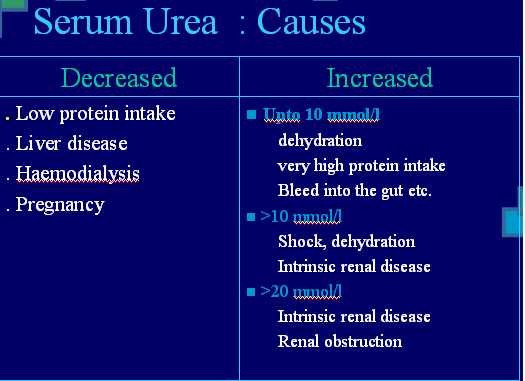
Urea
n Urea is synthesized in liver as a by –product of deamination of amino acids – Urea cycle
n Serum urea concentration is used for assessment of renal function
n Reference Range 2.5-6.7 mmol /L
Plasma Electrolytes
n Plasma Sodium (135-148 mmol/l)
n Early CRF - Normal
n ARF /Late CRF - Hyponatraemia
n Plasma potassium (3.5-5.0 mmol/l)
n Early CRF : Normokalaemia
n ARF /Late CRF : Hyperkalaemia
n Plasma Bicarbonate (22-28 mmol/l)
n ARF / CRF : Low due to metabolic acidosis
n Serum chloride (95-107 mmol/l)
n Early CRF: Increased
n Anion gap
n (Na +K) - (CI + HCO3) = upto 16 mmol/l
n Normal anion gap: early CRF
n High anion gap: Late CRF
n Serum calcium (2.05-2.55mmol/l)
n Reduced in RF
n Serum phosphate (0.8-1.45mmol/l)
n Increased in RF
n Serum Magnesium ( 1mmol/l)
n Increased in RF
ARF : Prerenal : Renal
n Urine sodium (spot)
n Helpful in D/D of oliguria
n PRU: Urine sodium < 20 mmol/l
n ATN: Urine sodium > 40 mmol/l
n Renal fractional excretion of sodium
n FE Na < 1%: PRU
n FE Na > 1%: ATN, Obstructive nephropathy, CRF
n Urine : plasma osmolality
n PRU > 1.5 : 1
n ATN < 1.1 : 1
n CRF 1 : 1
Other tests
n Blood Complete and E.S.R
n Anaemia
n Abnormal T.L.C and D.L.C
n Plasma and urine electrophoresis if suspect multiple myeloma with Bence Jones proteinuria
n Urine for myoglobin / haemoglobin
n Renal biopsy if suspect glomerular disease
n HbA1c to assess diabetic control
n Renal ultrasound if suspect renal disease
n Plain and contrast X-ray
n C.T and M.R.I


This is the best blog I’ve ever seen in my life! I really appreciate you taking the time out of your busy day to share your this with everyone.
Great blog!! You should start many more. I love all the info provided. I will stay tuned 🙂
Thanks for publishing relating to this. Presently there?utes a mass of important tech info on the internet. You?ng got lots of which info here upon your site. We?m impressed ? I try to maintain a couple weblogs pretty on-going, but it?s difficult sometimes. A person?ng carried out a fantastic job with this one. How do you do it?
Very nice post and right to the point. I am not sure if this is truly the best place to ask but do you folks have any thoughts on where to get some professional writers? Thanks 🙂